Wednesday, September 25, 2013

Stoned in Thailand (not the drug kind of stoned, nor the lapidation kind)

On our way between Vientiane and Bangkok, we made an overnight stop in Nong Khai, near the border. It so happens that we went to 2 sites that contained weird stone structures, and we liked it a lot.

Within Nong Khai, we explored the Sala Kaew Ku sculpture park, where a hundred or so gigantic and psychedelic statues are jammed into a small park. There were zero explanations in English so we have no idea what these sculptures represent, but it was a fun sight.


AAAAahhhhh, help!


The next day, we rented a scooter in order to get to Phu Phrabang Historical park. This site, almost 2 hours away from Nong Khai, was a bit of a bargain as it is a little visited site (it was not even in our lonely planet guide), but we were not disappointed! This historical park was a place of worship about 2,000 years ago.
Inhabitants from the region took advantage of existing, unusual rock formations, which they carved into in order to create even more unusual structures. The balance of some of those structures are still a mystery to us, but regardless we are happy to report that neither of us got squished by a menhir, Asterix-style.


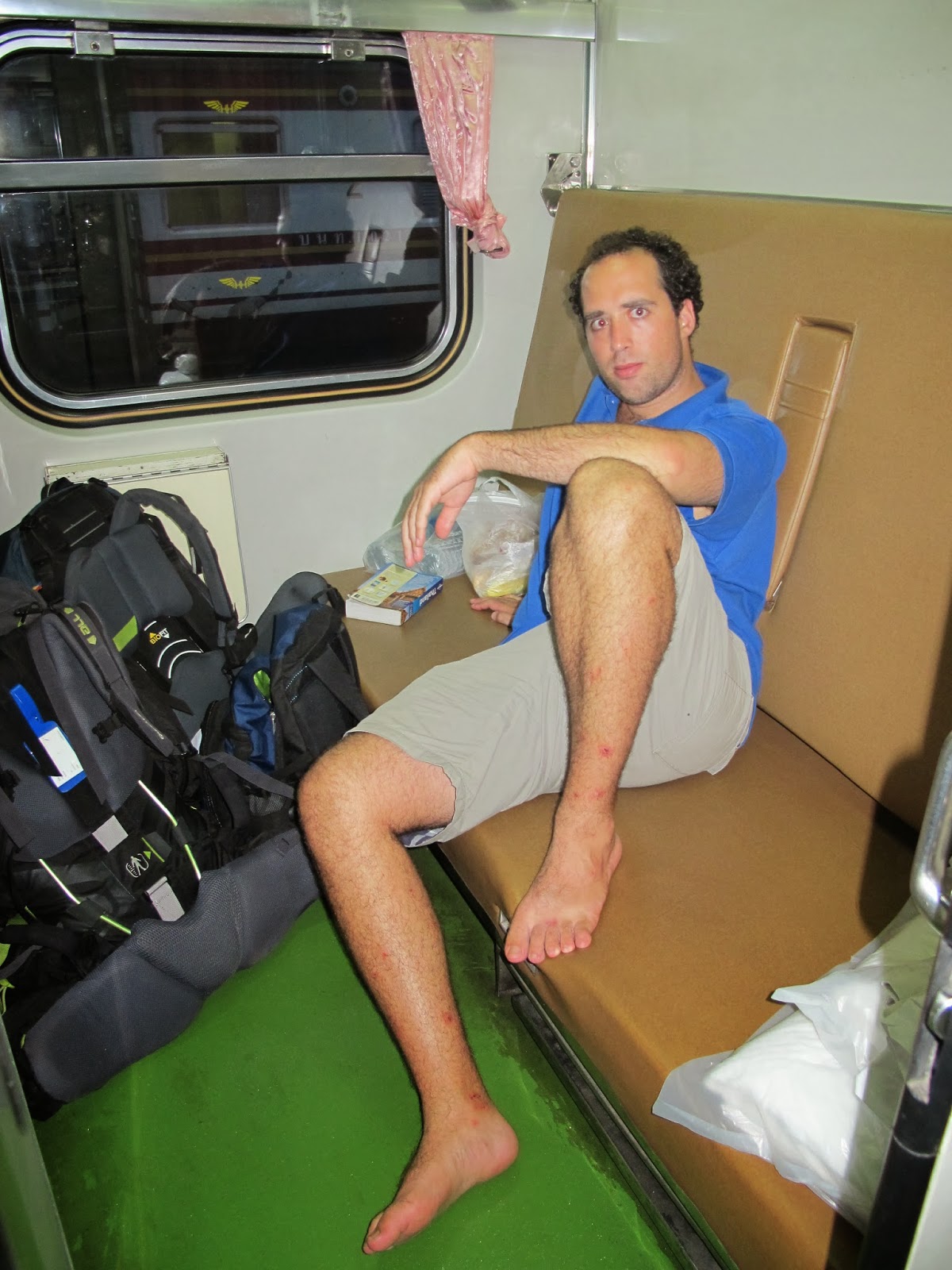
And now, off to Bangkok VIP style, 1st class night train here we are!


The best part about this train is that we look really good in every picture we took.
modelling our luxurious private cabin which contained a sofa that was later converted into a bed

Fancy dinner picnic

so fancy

more modelling
Jeremy and Alina,
Best Prices for Nonsense Guaranteed; Contact Your Local Dealer

VIP's in Laos (VIP = Violent Impulse to Panic)

Today, we walked across the border from Laos to Thailand. We walked quickly, without looking back, full of excitement, joy and relief. Here is why...

Thailand: the promised land

After a few days in the idyllic north and in the ancient capital, we headed to the political capital, Vientianne.  We bought tickets for the VIP bus to ensure we'd get some sleep and we prepared for the grueling 10 hour bus-ride by making sure we were full and exhausted before getting on the bus.  The bus was old and cramped, they double-booked our seats, and we left late.  But once it was all sorted, we sat down and fell asleep.

ZzzzzzzzzzzzzzzzzZzzzzzzzzZzzzzzz [fart] ZZZZZzzzzzzzzzzZZZZZZZZzzzzzzzzzzzz

One hour in, there's a scream in the back.  We look back.  There's smoke.  People shout, "Get out!  Get out!"  Everyone jumps out in a panic.  It's pitch black here on the Laotian mountainside, and we all hang out in the rain trying to understand what happened, which was this: the engine overheated, there was a hole in the bottom of the bus.  The overheated engine started spraying scalding water and steam and some of it came into the bus, burning a passenger's leg.  

In the meantime, another passenger administers first aid, consisting of pouring some water on the man's burn and wrapping it with a scarf.  20 minutes pass and the driver turns up, looking very relaxed. Warmly, he suggests that we get back on the bus because all is well.  (How did he fix this problem, you may ask?  We asked just this and he explained that he poured some cold water on the engine, thereby cooling it down and ensuring our safety.)

The locals hesitated to get back on but the foreigners straight up flipped out.  The 20 of us bonded together, first trying to reason with the driver and crew, we pleaded for them to call another bus, we begged, and then we resorted to protest.  We refused to mount the bus.  They couldn't possibly leave 20 of us there in the dark, could they?

In fact, they did just that.   So the 20 of us started walking along the road.  Fortunately (I guess), the bus broke down just 1 kilometer later so we caught up quickly and - with our bargaining position weakened - reluctantly got on the bus.  In order to keep anyone from having to sit above the engine, we all crowded into the first 10 rows and aisle of the bus.  And so, for the next 14 hours, we crawled along the road (no AC, obviously, so as not to overwork the engine), stopping every hour for 30-40 minutes in order to pour some water on the engine. The ride was rough. The guitar playing helped a bit, but soon internal unrest (aka, some crazy jerk woman) arose. 

A guy started playing the guitar and singing to try to ease up the mood. But he soon stopped because we realized that we needed to keep the noise down so that we could hear potential screams coming from the back of the bus

But finally, we arrived.  We kissed the ground, we laughed, we cried, we hugged, and we all vowed to get out of Laos as soon as possible.  Why?  Because this is just how things work here!  This miserable bus was reloaded with people after we arrived!  

So, today, we walked - no, ran - accross the Laos-Thai border at Vientianne.  There were buses, but we just could not risk it.

This sign epitomizes everything we found problematic about Laos. 
How will they know that we threw the towel on the floor and then picked it up, you may ask? Well, we have several theories about it: hidden cameras, sensors embedded in the towel, telepathy...

Our Laos guidebook talks about a country where there's no need to haggle because the people are welcoming of tourists and businesses are not yet overcharging. This was almost true of the rural north, but patently inaccurate and outdated when it came to Laotian cities.  There, tourism seems to have entered a new phase: a few people have realized how profitable tourism is - but because there's no transparency and no competition, they have no incentive to provide good service.  They seem to count on the fact that tourists have no choice but to use their services once they are there.  Generally speaking, we also felt a hostility towards foreigners that we hadn't felt in other places. 

We did not like Laos. We loved its nature and landscape. We understand that this is still a rather closed country, which has been through a lot (in particular: dramatic collateral damage from the Vietnam war), is dependent on expensive imports, and is overall in much worse shape than its neighbors. We were prepared for poor infrastructure and a slow pace, but we were also expecting a warm and welcoming country. 

You're beautiful, Laos, but so are Thailand, Vietnam, and Cambodia, and they seem to like us better. 

Jeremy and Alina,
Getting Out of There


We were walking on a bit of a highway in order to get through the border, but it seemed safer than taking a bus from Laos

WE MADE IT OUT!!! WOUHOUUUUUU

Tuesday, September 24, 2013

The Lives of Athletes in Luang Prabang

We had a pretty sporty day in Luang Prabang in order to visit the nearby Kuang Si waterfalls. The waterfall is more than 30km away, with a very hilly road, but since we are athletes, we decided to rent some mountain bikes in order to go there. It was not easy, and it took us more than 2.5h, 8 breaks, 4.7 liters of sweat (Jeremy contributed most of that), and a lot of perseverance to get there, but it was well worth effort! the falls were really spectacular, and we got to enjoy a wonderful thon-chips.

We would like to take a break here, and reveal to our readers the recipe of "thon-chips" (tuna-chips). Thon-chips is a renowned French specialty created by the Katz brothers circa 2007 in south America. From there, the dish quickly expanded worldwide, to become the culinary phenomenon that we know today.Contrary to what the name may lead you to think,  this healthy dish is not made of tuna and chips, but of bread, tuna and chips. 

If you would like to prepare this dish at home, here are the steps:

  1. Buy some bread (sliced bread is fine, baguette works well too), chips, and canned tuna (tuna in oil is preferred for softness, although tuna in water provides for an even healthier option)
  2. Find an amazing spot. This should usually require at least 2hours of physical effort (walk,hike, bike, ski, etc), culminating in finding an amazing spot with an incredible view.
  3. Sit down in your amazing spot. Make sure that it is amazing enough
  4. Insert tuna and chips between 2 slices of bread. Squish the chips by pressing the slices of bread together
  5. Enjoy!

But we digress... We really liked the falls, and went back to Luang Prabang with a tuk-tuk (because we are athletes, but we are not crazy).
In Luang Prabang, we also enjoyed the street food (amazing night market with barbecued fish, delicious), cool views, and a few quiet days. We also woke up at dawn once in order to witness the monk alms, a daily ceremony where a procession of monks walks the street and receives tiny donations of food from people. It's just like Halloween in the US, except you get rice and bananas instead of candies.

Jeremy and Alina,
Bringing You Our Secrets to Nonsense

Views on Luang Prabang


Monk alms ceremony


Athlete #1

Athlete #2

Athlete #3 (yes, this bear is chilling in a hammock)

Being marvelous at Kuang Si falls


I will have that fish please


Making a Tigron, by mixing Tiger and Lion


Saturday, September 21, 2013

Hello Laos

Our first stop in Laos was in Muang Khua, and - because we know that roads in the north are treacherous - we traveled south to Nong Khiaw and Luang Prabang by water. These cities are connected by the Nam Ou river and the ride in a home-made canoe-type vehicle was absolutely spectacular. We are buying a boat in Manhattan as soon as we get back. Is anybody selling one by any chance?

Muang Khua and Nong Khiaw are both quiet, tiny towns, with a very laid-back atmosphere, limited tourism, spectacular landscape, and great food. Obviously, we enjoyed all of that. We also did some very hardcore partying, to the extent that it was possible...


Look, we're on a boat

Foot picture. Classic

Nam Ou river views

Nong Khiaw

This is the most formal map that we found of the area


There was not even phone service in the area

Views on Nong Khiaw from the second highest peak


PARTYING PICTURES:


View from our hotel

That's the life

Jeremy peeking out the window from our Muang Khua bungalow


Nong Khiaw by day
Nong Khiaw by night


Biking to nearby caves, which were used for shelter during the Vietnam war (which, we now know, spilled over into Laos, making Laos the world's most bombed country, per capita.  Fun fact: more bombs were dropped on Laos during the Vietnam War than were dropped by both sides in WWII.)

Crossing the river to go to the caves (FYI: turns out the entrance to said caves was locked)


Our Nong Khiaw bungalow